
There’s a decision a lot of Newcastle landlords have been circling since the spring: keep letting, or get out.
It’s a fair question to be asking. But the answer changed on 1 May 2026, and it changed in a way that almost nobody is talking about. The Renters’ Rights Act didn’t just remove Section 21. It attached a consequence to the decision to sell that isn’t obvious from reading the headlines, and it’s the single most expensive thing a landlord can get wrong right now.
Getting your property back to sell it now costs you time, not just fees
If you want vacant possession in order to sell, you’ll almost certainly be using Ground 1A. It’s the new mandatory ground written specifically for landlords selling up.
Three things apply to be able to use it.
Notice is four months. Ground 1A sits in the four-month band under section 8 of the Housing Act 1988. Not two.
The tenancy has to have run twelve months. Precisely, the notice can’t expire before the tenancy’s first twelve months are up. You can serve during that first year, you just can’t get possession before month twelve.
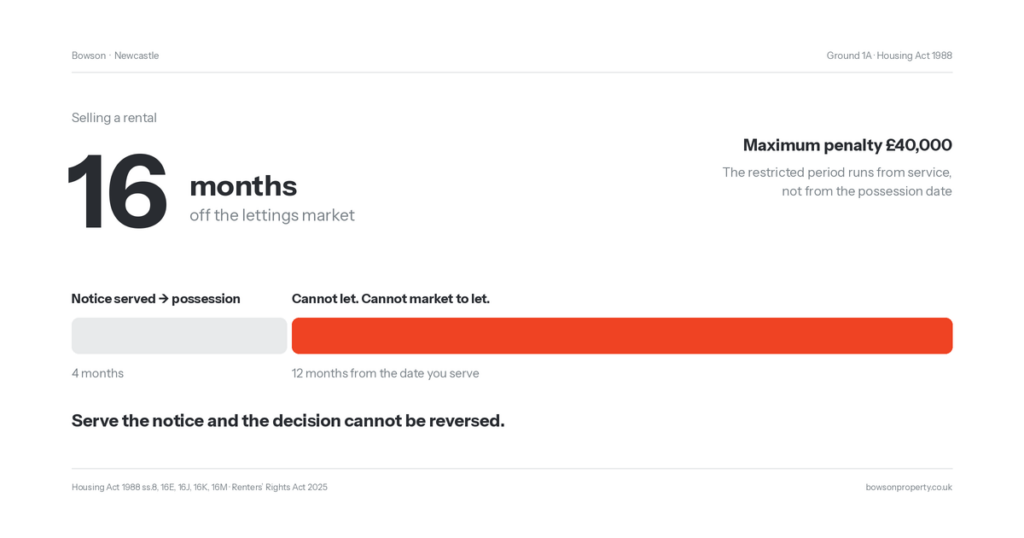
Then the property can’t be let for twelve months. This is the part that catches people. Under section 16E of the Housing Act 1988, once you’ve served that notice you can’t let the property or even market it to let. Section 16M sets when that runs: it begins on the day you serve the notice and ends twelve months after the possession date you specified in it. So if you changed your mind on selling, you can’t rent the property back out until that 12 month window expires.
Read those last two sentences again, because the arithmetic isn’t intuitive. Serve a four-month notice, and the restriction doesn’t end four months later or twelve months later. It ends twelve months after the possession date, which is itself four months after service.
Roughly sixteen months from serving notice to being able to let again.
The penalty for getting it wrong isn’t a slap on the wrist
Breaching the letting or marketing ban under section 16E is a criminal offence under section 16J. Alternatively, a local authority can impose a financial penalty of up to £40,000 under section 16K, where it’s satisfied beyond reasonable doubt that the offence was committed and hasn’t prosecuted.
You’ll see £7,000 quoted for this in a fair amount of what’s circulating. That figure belongs to a different section and different breaches. For letting or marketing during the restricted period, £40,000 is the number.
Worth noting too: legacy assured tenancies that existed before 1 May 2026 and were never assured shorthold tenancies are saved from Ground 1A entirely. If you have one of those, this ground isn’t available to you at all.
Why this changes the maths in Newcastle specifically
Here’s where it gets local, and where the decision stops being abstract.
Newcastle sold prices are up 3.7% on the year. But the postcode picture underneath that is not uniform. Sold prices for the twelve months to July 2026 showed the following:
NE2 at £347,855, down 3%
NE6 sits at £197,527, down 4%.
Meanwhile NE7 is up 6% and NE3 up 3%.
Now put the rental side next to it. Rents up 6.3% year on year — the highest annual rent growth of any English region.
So: in the two postcodes where a lot of Newcastle’s rental stock actually sits, capital values have gone sideways or backwards while rental income has risen faster than anywhere else in the country.
You’d be surrendering the strongest rental income growth in England, for over a year, in order to sell into a postcode market that is currently baseline — and if the sale falls through, you’ve still got the rest of the restricted period to sit out. You can’t simply put it back on the rental market and try again next year.
And the exit door isn’t as busy as you’d think
The “landlords are fleeing” story has had a long run. The data has quietly stopped supporting it.
Hamptons’ lettings index for June 2026, published 13 July, recorded the first month since 2019 in which landlord purchases exceeded landlord sales. Previously-rented homes fell to 9.2% of properties listed for sale, down from 11.3% a year before. The largest falls in landlord selling were in northern markets, which Hamptons attributed to stronger yields.
The North East is the sharpest version of this. Hamptons data found landlords were 23.8% of all buyers in the North East, against 9.1% across southern England and that 35.8% of North East buy-to-let purchases were previously-rented homes. Over the past decade, the North East is the only region in Great Britain where buy-to-let purchases have increased.
Read that last set of numbers carefully. More than a third of North East landlord purchases are one landlord buying from another. The stock isn’t leaving the sector here. It’s changing hands within it.
What this actually means
None of this says don’t sell. Some landlords should. A property that won’t reach the 2030 energy standard economically, a portfolio that’s become a second job, a genuine need for the capital — those are all real, and we’d tell you so.
What it does say is that selling is no longer a decision you can reverse cheaply. Before 1 May 2026, a landlord could test the sales market and, if it didn’t work, re-let. That option has gone. The decision now carries roughly sixteen months of committed downtime, in a market where your rental income is growing faster than in any other English region and where the buyer most likely to take the property off you is another landlord.
The landlords getting this right aren’t the ones deciding faster. They’re the ones running the numbers before they serve anything — because the notice is the point of no return, and there isn’t a way back through it.