
Every private landlord in England is going to register on a new government service called Register your rental property: once for themselves, and once for each property they let. It opens region by region. In the North East, which takes in Newcastle and North Tyneside, registration opens on 15 June 2027 and the deadline is 14 September 2027.
It costs £65 a property, every year. And most of what it asks for is paperwork a compliant landlord already holds: the gas safety record, the electrical report and the EPC. So for most landlords the registration itself will be a form. The part worth doing before next June is making sure those three documents are current, because the register is where a gap in them becomes visible.
When do Newcastle landlords have to register?
Between 15 June and 14 September 2027. The government set out the timetable in its guidance, updated on 10 September 2026, and the North East is seventh of nine regions. The West Midlands goes first, opening on 15 December 2026. The South West is last, closing on 14 November 2027.
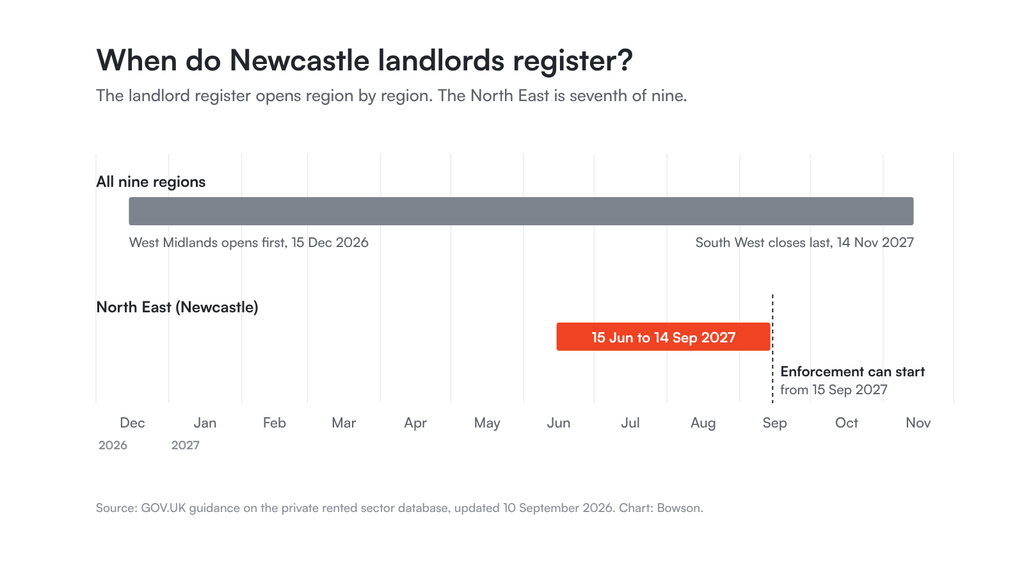
The guidance says that once a region’s deadline passes, councils there can begin enforcement. For Newcastle, that’s from 15 September 2027.
Who has to register?
The landlord, for any property let on an assured tenancy, which since 1 May 2026 is almost every private tenancy in England. The landlord gets one entry and each property gets its own, and both are given a unique identifier.
If an agent manages the property, the duty still sits with the landlord. The guidance says the landlord starts and ends the registration and can agree that their agent provides some of the information, but the landlord remains responsible for all of it.
If the property is empty between tenancies, it doesn’t need registering at launch. Only properties that are let, or become let during the rollout, do. The government has said future legislation will require empty properties to be registered before they’re marketed, but that hasn’t been made yet.
What information does the register ask for?
It asks for five groups of information:
- About you: name, date of birth, home address, phone and email. A company gives its details, its directors and its Companies House number instead.
- About the property: address, whether you own it freehold or leasehold, the type of property, the number of bedrooms, whether it’s currently let, and the freeholder’s details if there is one.
- About the tenancy: how many people live there, how many households, whether it’s licensed as an HMO, and whether it’s furnished.
- The rent: how much, how often it’s paid, and whether any bills are included.
- Safety: the gas safety record, the electrical installation condition report (EICR), the EPC, and any energy efficiency exemption.
The first four are admin. The last one is the only part of the register that is really a check.
The gas safety check has to be done at intervals of no more than 12 months. The electrical inspection has to be done at least every five years, or sooner if the last report said so. And the EPC, as the law stands today, has to be rated E or above. A landlord whose paperwork is in date will upload three documents. One whose gas certificate lapsed in the spring, or whose EICR has quietly passed five years, will find out while filling in the form.
The HMO question matters more in Newcastle than in most places, because the city licenses shared houses of three or more people from two or more households everywhere, not only in the student streets. We covered how that works here. A three-person let with no licence will show up as exactly that.
What does it cost?
£65 per property, renewed every year. Three flats is £195 a year.
The figure comes from the government’s guidance. The draft regulations themselves don’t fix an amount; they leave it to the organisation running the database to set by reference to its costs. So £65 is the published figure rather than one written into law, and it could move.
What happens if a landlord doesn’t register?
The Act lets a council impose a penalty of up to £7,000 for breaching the registration rules. If the breach carries on after a penalty, or a different breach follows within five years, it becomes an offence, with a penalty of up to £40,000.
The consequence more landlords are likely to meet is less obvious. Under section 90 of the Act, a court can’t make a possession order while the landlord is in breach of the duty to be registered, except on Ground 7A or Ground 14, the two grounds dealing with serious criminal and antisocial behaviour.
Since 1 May 2026 there’s no section 21, so every possession claim goes through a ground. Once the duty applies here, an unregistered landlord who needs the property back to sell it, or because the rent hasn’t been paid, has no route through the court until the registration is done. That’s a reason to register on time that has nothing to do with the council.
What’s still undecided?
- The regulations are still in draft. They were published on legislation.gov.uk and last updated on 9 September 2026, but they haven’t been made. The dates and the detail could still change.
- Registration numbers on adverts. The Act requires the landlord’s and the property’s identifiers on any written advert. The guidance describes this as a future requirement with further guidance to come.
- Empty properties. As above, future legislation.
- What tenants will see. The guidance says tenants will be able to use the service to check whether a landlord is compliant with key legal requirements, balanced against landlords’ privacy. It doesn’t yet say what that looks like.
That last one is worth thinking about. If it works as described, a tenant choosing between two similar flats will be able to see which landlord has their paperwork in order. For a well-kept property, that’s an advantage rather than a burden.
So what’s worth doing before June 2027?
Not registering, because the North East window isn’t open yet. What is worth doing is checking three dates: when the gas was last checked, when the electrics were last inspected, and when the EPC runs out and what it’s rated. If the EPC is borderline, the 2030 target of C is closer than it looks, and money spent on the property from October 2025 already counts towards it.
For a landlord whose paperwork is current, the register is a £65 form filled in some time next summer. For one whose isn’t, it’s a three-month window to fix things that should already have been fixed. The North East window opens on 15 June 2027, which leaves enough time to make sure it’s the first.
If you’d like the paperwork on a property checked against what the register will ask for, Bowson’s lettings team can go through it with you.